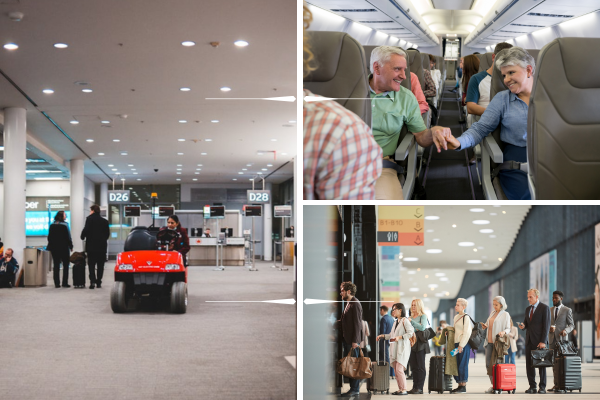
If you’re a baby boomer who loves to travel, you might have noticed something that nobody talks about enough. If you haven’t noticed, I’m here to spill the beans, because honestly, the airports can be a little QUIET about it. I’m talking about a whole menu of travel perks that might not even know exist that are reserved for those of us who are older. Some of these benefits are official. Some are “soft perks” that come from simply knowing what to ask for. And a few are the kind of thing that feels like a secret handshake. Not because anyone’s trying to hide them, but because most people don’t think to look.
That’s why I knew I had to put together a practical, feel-good guide to what baby boomers often get when they travel that others don’t. It’s also a roadmap for where to find the best perks, who offers them, and how to actually claim them without feeling awkward or like you’re “making a fuss.” Because you’ve earned the right to travel smarter, easier, and yes, sometimes cheaper.
Airport help, without being “handicapped”
Let’s start with the big one, because it changes everything. You can request airport assistance even if you are not disabled in the way people picture disability. You do not need to be in a wheelchair. You do not need to be visibly struggling. You do not need to justify anything to strangers.
If long walks through terminals wear you out, if standing in long lines triggers back pain, if you get anxious navigating huge airports, or if you simply want less stress, you can request assistance. Airlines and airports provide a range of services, including:
-
Wheelchair service (even if you can walk. This is often used for long distances, tight connections, or energy conservation.
-
Electric cart rides between gates in some airports
-
Escort assistance through the airport, including help finding gates and navigating connections
-
Priority or separate lines at certain checkpoints or boarding areas when you are traveling with assistance
Here’s how to get it:
-
When booking your flight, look for “special assistance” or “accessibility services” options.
-
If you already booked, log in to your reservation and add it, or call the airline.
-
You can also request it at the airport, but it’s smoother if it’s already on your reservation.
Pro tip: If you’re traveling with a companion, you can usually stay together during the process, but rules can vary by airport and airline. If you’re nervous about this, ask at the check-in counter: “If I request assistance, can my travel companion accompany me?”
The boomer advantage. Many people don’t know they can do this without “qualifying.” You do. And it can turn a travel day from exhausting to manageable.
“Modified” TSA screening, and why it matters
Airport security is where travel moods go to die. Shoes off, laptop out, liquids in tiny bottles, pockets empty, and everyone acting like they’re late for a rocket launch. Baby boomers often have an edge here because you’re more likely to take advantage of programs and screening options that make security less of a hassle.
TSA PreCheck and Global Entry
These aren’t age-specific, but baby boomers use them at higher rates because once you experience a calm, faster security line, you don’t go back. With TSA PreCheck, you typically keep your shoes, belt, and light jacket on, and you don’t have to pull liquids or laptops out in many cases. Global Entry helps with expedited re-entry into the U.S. from international trips and includes TSA PreCheck benefits.
How to get it:
-
Apply online, schedule an appointment, and complete a background check.
-
Many travel credit cards reimburse the application fee.
TSA Cares and screening assistance
TSA Cares is a program designed to help travelers who need additional support to get through screening, including older travelers who have medical conditions, mobility concerns, or anxiety about the process. You can request a passenger support specialist to guide you.
How to use it: Contact TSA Cares in advance (typically at least 72 hours before travel) to request assistance.
Medical devices, medications, and dignity
We older people often travel with more “stuff,” and that can complicate security. Medications, CPAP machines, knee braces, implants, hearing aids, and mobility supports. The good news is that TSA has procedures for this, and you can ask for a private screening if you prefer. You can also notify the officer if you have joint replacements or medical devices that may trigger alarms.
The boomer advantage: You’re more likely to advocate for yourself politely and confidently. That’s not entitlement. That’s experience.
Priority boarding and easier seating wins
Again, not always “senior only,” but boomers tend to benefit more because you’re more likely to choose comfort-forward options and loyalty programs that quietly make travel easier.
Ways boomers often get boarding perks:
-
Airline credit cards that include priority boarding
-
Loyalty status earned through travel frequency
-
Purchasing upgraded economy seating (extra legroom sections), which often board earlier
-
Traveling with assistance services, which sometimes includes early boarding
Why this matters: Early boarding gives you overhead bin space. It gives you time. It reduces the jostling. It means you can settle in without feeling rushed. That alone can change the whole vibe of your flight.
Senior discounts on airlines, and how to find them
Here’s the truth: Airline senior discounts exist, but they’re not always advertised loudly, and they’re not always the best deal compared to sales. Some airlines offer limited senior fares on select routes, often with specific rules.
How to find airline senior discounts:
-
Search the airline’s site for “senior fares” or “senior discount.”
-
Call the airline directly and ask, “Do you offer any senior fares on this route?”
-
Compare the senior fare to promotional fares. Sometimes the “senior fare” is more flexible, not cheaper.
Some travel booking sites also allow you to filter by senior fares, but availability varies.
The boomer advantage: You’re more likely to pick up the phone and ask. That simple act can unlock options that aren’t visible in an app.
Hotels, restaurants, and attractions. The senior discount trifecta
This is where baby boomers can really clean up. Discounts in hospitality are widespread, but they’re often hidden behind a tiny link, an unadvertised policy, or a membership.
Hotels
Many major hotel brands offer senior rates, often starting at age 60, 62, or 65, depending on the company. These rates can be a percentage off the “best available rate” and sometimes come with flexible cancellation terms.
How to get them:
-
When booking directly on the hotel website, look for “special rates,” “discounts,” or “senior.”
-
Call the hotel and ask if they offer a senior rate that isn’t visible online.
-
Be prepared to show ID at check-in.
Pro tip: Always compare:
-
Senior rate vs. AAA or AARP rate
-
Senior rate vs. member rate (free loyalty membership)
-
Senior rate vs. promotional packages
Sometimes the best value is a package that includes breakfast or parking rather than a straight percentage off.
Restaurants
Senior discounts at restaurants are often location-specific or franchise-dependent, which means one location offers it, and another doesn’t, even within the same chain. Some restaurants offer:
-
A percentage off the bill
-
A senior menu with lower prices
-
Free beverages or discounted breakfast specials
How to get them:
-
Ask casually when ordering: “Do you have a senior discount here?”
-
Check the restaurant’s website or local listings
-
Join restaurant loyalty programs. Sometimes the “senior discount” has quietly been replaced by app-based rewards
The boomer advantage: You’re not shy about asking, and you don’t feel weird about wanting a deal. You shouldn’t.
Attractions and museums
Museums, national landmarks, theaters, botanical gardens, and guided tours often offer senior pricing. Sometimes it’s only a few dollars, sometimes it’s significant.
Where to find these discounts:
-
The attraction’s ticket page. Look for “senior” under ticket types
-
City tourism cards or passes, which may include senior pricing
-
Local visitor centers, which sometimes have printed coupons or discount booklets
The memberships that quietly unlock travel perks
If you’re a boomer, you probably already belong to at least one organization that can save you money on travel. The key is knowing where to look and stacking benefits without overpaying.
AARP
AARP is the heavyweight champ of boomer-friendly travel perks. It’s not just discounts. It’s an entire ecosystem of negotiated rates with hotels, car rentals, cruises, tours, insurance, and sometimes even vacation packages.
How to use it well:
-
Search AARP’s travel discount directory before you book
-
Use the AARP rate code when booking hotels or rental cars
-
Ask if the AARP discount is available if you’re booking by phone
-
Carry your digital card or have your membership number handy
AAA
AAA can be incredible for hotel rates, roadside support during road trips, and curated travel services. Sometimes, AAA rates beat senior rates. Sometimes they don’t. The point is to compare.
Military or government retiree discounts
If you or your spouse has military service or qualifies for government retiree perks, you may have access to travel discounts beyond standard senior offers. Always check what benefits exist for your specific status.
Cruises. The boomer advantage category
Cruises are practically designed around what baby boomers love. Comfort. Ease. Value bundling. Unpacking once. Dining choices. Entertainment. And on many lines, there are perks that are either senior-friendly by design or offered directly as “seasoned traveler” incentives.
Boomer travel perks on cruises often include:
-
Resident or age-targeted promotions
-
Loyalty program perks that grow quickly with repeat sailings
-
Onboard accessibility support that makes everything smoother without feeling medicalized
-
Dining accommodations that are handled with grace
-
Shore excursion assistance options for those who want a little extra support
How to maximize it:
-
Book with a travel advisor who understands your preferences and can add perks like onboard credit
-
Watch for limited-time promotions that bundle Wi-Fi, drinks, gratuities, or specialty dining
-
Join the cruise line’s loyalty program even if you only cruise occasionally
The soft perks. The ones nobody lists
This is the part no one prints in a brochure, but it’s real.
Baby boomers often get better travel experiences because they bring something younger travelers are still building. Patience. Confidence. Communication skills. You’re more likely to:
-
Speak up early when something feels off, which leads to faster solutions
-
Ask for the quiet room, the higher floor, the extra pillow, and the later checkout
-
Tip thoughtfully, and that often results in better service
-
Travel with a “we’re here to enjoy this” mindset instead of “we must optimize every second.”
You also know how to pivot. Flight delayed. Gate changed. Hotel room not ready. You’ve lived enough life to know that you can roll with it and still have a great trip.
How to actually claim these perks without feeling awkward
Here’s a script you can use anywhere, and it works because it’s simple and polite:
-
“Do you offer a senior discount?”
-
“Is there a special rate for travelers over 60?”
-
“Are there any discounts available that might apply to me?”
-
“What’s the best rate you can offer if I’m flexible on dates?”
-
“Can you note my reservation for assistance at the airport?”
If they say no, that’s fine. No drama. If they say yes, you just saved money or stress in under ten seconds.
Travel as a baby boomer isn’t about getting older. It’s about getting smarter. It’s about realizing that comfort is not a luxury; it’s a strategy. And it’s about using the perks that exist. Some are official programs, some are discounts, and some are simply the result of knowing what you’re allowed to ask for. The world doesn’t hand these benefits to you in a neat little envelope. But once you know where to look, travel gets easier, calmer, and often less expensive.
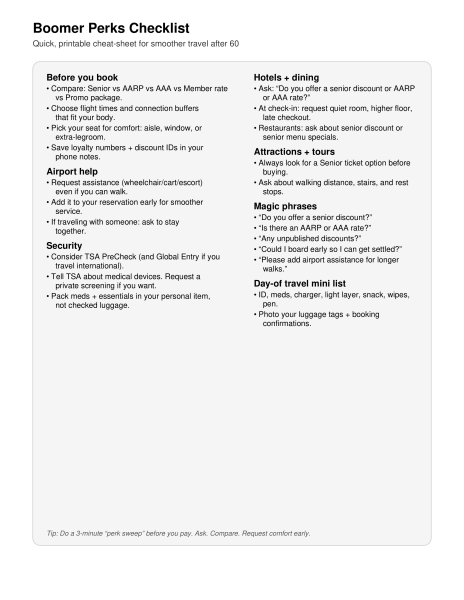
Here’s an easy checklist for you to download and print, so you ALWAYS get the perks you deserve when traveling. Simply right-click and then download or print.